XP-Panel Wants to Make cPanel Feel Old

For the last two decades, if you ran a website on a shared server, you probably stared at the same beige dashboard: cPanel. Or maybe DirectAdmin, or Plesk. They work — but they were designed for a web that no longer exists, back when "the cloud" was just somebody else's computer and nobody had heard of a container.
XP-Panel is a new open-source project that thinks it's time for a reset. Its pitch is blunt: faster than DirectAdmin, more powerful than cPanel, more modern than Plesk. Here's why that's an interesting claim worth watching.
It's actually open source
This is the big one. cPanel, DirectAdmin, and Plesk are all paid, closed-source products — you pay a monthly license fee just to manage your own server. XP-Panel is released under the AGPL-3.0 license, meaning it's free to use, modify, and run commercially. For anyone who's winced at a cPanel renewal invoice, that alone is a reason to pay attention.
Built for how servers actually work now
The older panels were built around a single machine running Apache and PHP. XP-Panel is built around a modular architecture of independent services — auth, DNS, mail, backups, billing, and more, each doing one job. It's designed to play nicely with Docker and Kubernetes out of the box, rather than treating containers as an afterthought bolted on years later.
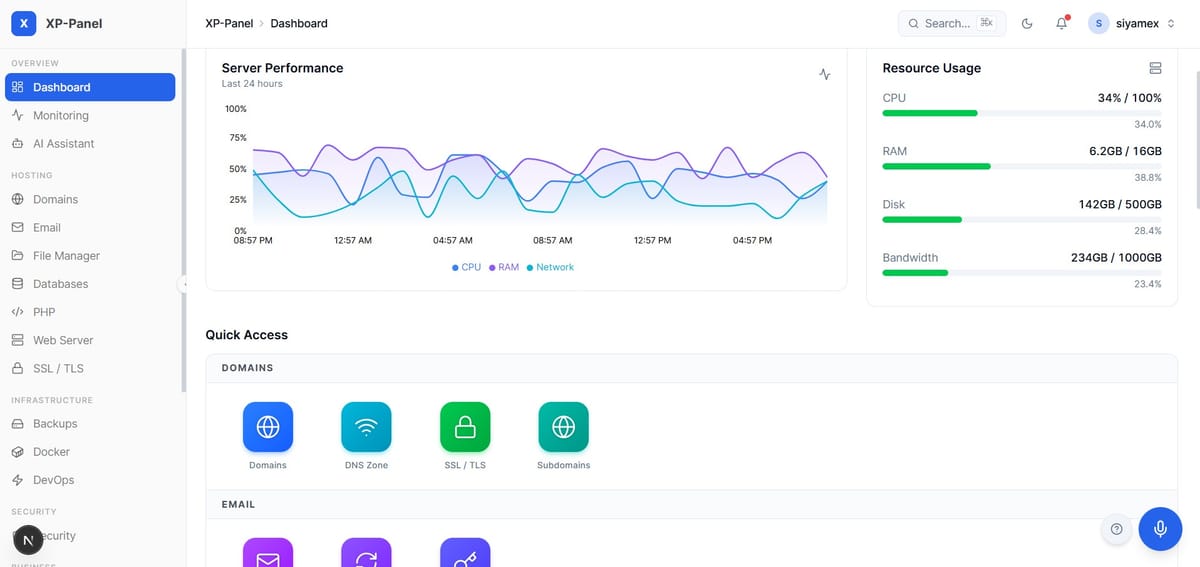
Under the hood it uses Go for the backend and Next.js for the interface, which is a modern, fast pairing. The practical upshot is a dashboard that feels like a 2026 web app instead of a 2006 one — real-time metrics, a command palette, and a genuinely current design.
The features the incumbents don't have
Beyond matching the basics (domains, DNS, email, databases, SSL), XP-Panel leans into things the old guard simply never built:
- An AI assistant you can give plain-English commands like "optimize this server" or "fix email delivery."
- A 3D globe that visualizes incoming attacks and traffic in real time — equal parts useful and showing off.
- Built-in DevOps pipelines for Git deployments and CI/CD, so developers don't need a separate toolchain.
- Self-healing hooks that aim to auto-remediate common failures before you wake up to them.
Some of this is clearly ambitious, and some is experimental (voice control, for instance). But it sketches out a vision of a control panel that does things rather than just displaying them.
The honest caveat
XP-Panel is early. It's a young project with a small footprint on GitHub, and a feature list this broad takes real time to mature into something battle-tested. The README marks a lot as "completed," but production hosting is unforgiving, and the proof will be in long-term stability, security, and community adoption. This is one to try in a test environment before betting a client's website on it.
Worth a look
The hosting-panel world has been stagnant for a long time, and competition is healthy. Whether or not XP-Panel becomes the cPanel-killer it's aiming to be, it's asking the right question: why should managing a server still feel like using software from 2006?
If you're curious, it's free, and it spins up with a single Docker Compose command. Sometimes that's all the reason you need.